
Being good at a job is not the same as being good at the job that supervises it, or wanting to supervise in the first place. In fact, the desire to take charge of people and resources is one of the lowest motivators for most people.
However, people take promotions to a manager position for a variety of other reasons they are motivated by, such as more money, recognition, or a sense of increased accomplishment. The result is someone in charge who is not motivated to be in charge.
It’s no wonder that disengaged managers are the number one pain point for an organization’s culture and productivity.
Get to know the Director motivator
That motivator behind being in charge is called the Director motivator. Of the nine basic motivators we all carry, two or three are most important to us — if they’re fed, we remain energized and satisfied at work. By contrast, our lowest motivator indicates where we are least energized. If we constantly have to do work that demands our lowest motivator, we will be highly demotivated at work.
With the motivational platform mojoTM , managers can see which employees score high on Director and which employees score low. This is good news in both directions. Leave a strong contributor with a low Director where they are but find a way to meet their top motivators. You will likely keep them, and they will keep the energy that running other people would have taken. Find the people whose Director sits near the top, and you have the ones worth developing for leadership positions.
What a high Director motivator looks like
Employees with a high Director motivator want influence over outcomes and over the people and resources that produce them. They value taking charge, making decisions that matter, and carrying real weight in the organization. Remove that influence, and their satisfaction drops quickly, whatever their title says.
Responsibility motivates them even when it is contained in a single project, a work stream, or one process they own end to end. That is what makes this motivator useful to you before any promotion happens.
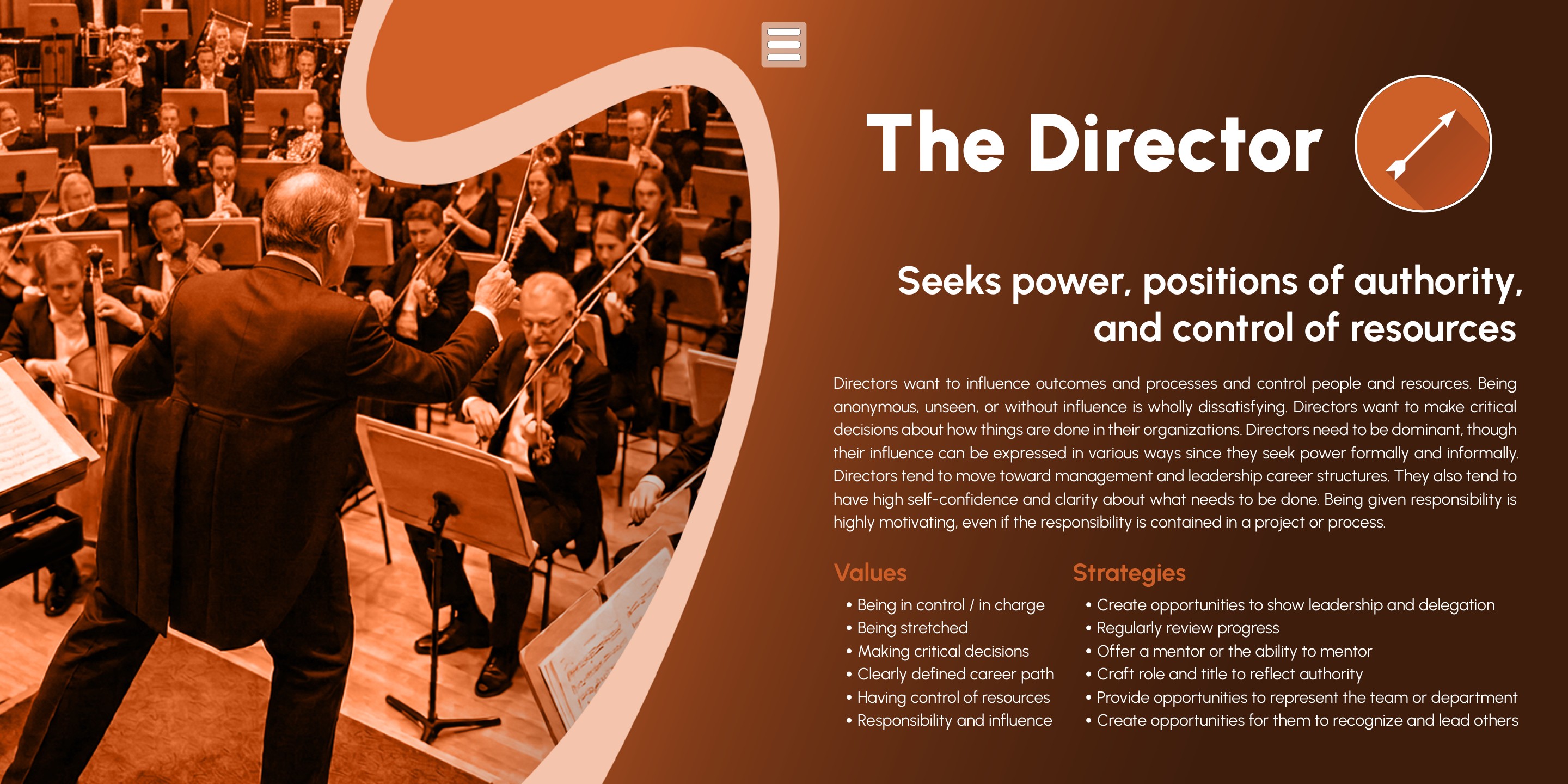
The "Director card." Click image for a full view.
Read the map, then have the conversation
Ask someone whether they want to manage, and you often get an honest answer to a different question — whether they want the raise and the title. A motivational map on its own has the opposite limit: it tells you where Director sits today, not what happens when this particular job is put in front of this particular person, or what might motivate that person three, six, or twelve months from now.
What a map does do is inform a better conversation about the role, responsibility, and energy required to stay engaged.
When Director sits at the bottom of someone’s map, discuss carefully what a management role would actually take day to day, rather than treating a “yes” as settled.
When Director sits in the middle, conversation matters most. While many employees are indifferent to managing in the abstract, some may light up — the Director motivator may move up in their ranking — given the chance to run something real. Others may decide a management role is not for them.
When Director sits near the top, you are mostly confirming what you already suspect.
Watch what people do, too: who volunteers to run a meeting, who asks to represent the team upward, and who keeps picking up responsibility without being handed it.
Curious which of your employees have a strong Director motivator? Get in touch to learn more about mojo.
Hand them some responsibility and let them make real decisions
Responsibility energizes the Director motivator, even when the scope is small. Give a high-Director employee a cross-team initiative with a deadline and a named lead. Let them run the status meetings and represent the group to leadership or other stakeholders. Give them small opportunities to lead as your particular organization defines it.
Authority is not authentic when it can be overruled quietly, and employees driven by Director are often aware of the difference. Delegate a decision with a defined budget and a clear boundary. Obviously you cannot let work go off the rails, but intervene only as a last resort and present it as an opportunity for problem solving or course correction.
A decision they can actually make, including one that turns out badly, tells them more about their standing than praise does.
Offer a mentor, or let them mentor
While the idea of being mentored or being a mentor might seem like it naturally belongs in the relationship cluster of motivators (Friend, Star, Defender), the Director motivator is driven by the influence and leadership components in the mentor relationship.



If possible, pair your people who have a high Director motivator with someone senior in the role or in leadership who can give them insight into the organization, especially if it relates to guiding planning decisions. Similarly, high-Director employees are often good candidates for mentoring junior or new employees.
Build the pipeline before you need it
Companies make promotion decisions through managers who mostly use the same instinct: promote the strongest performer. Sometimes this works well, and sometimes it does not.
An alternative structure can turn the coin flip into something more certain to succeed. Create cross-functional leadership roles — chairing a committee, sponsoring a task force — so influence is available without a headcount change or change to the organizational chart.
Then use mojo to map the motivation of everyone in the company. Find where Director sits across teams and whether satisfaction on it is holding. Employees retake their maps quarterly, so you can tell how much impact your development plan is having and can make adjustments.
Before you make the offer
When a role opens and an obvious candidate comes to mind, you already know they're a good employee. People naturally say yes to an ask in an organization, especially people who are contributing and engaged. But the better information — about whether they are motivated to lead — is in their mojo map. That's worth finding out before the offer goes out, not six months later when a good employee has become a struggling manager, and nobody can say why.
Book a discovery call to see what your organization's motivators look like.
Additional Reading
Keep Employees Connected: Supporting the Friend Motivator
The 9 Things That Drive Your Employees